


The “Shenxian Shui” Trademark Dispute: Can Common Words Become Exclusive Brand Rights in China?
By Kian Li, Founder of Huixinhe IP
Category: Trademark Strategy & Enforcement
Published: August 2026
Introduction
In recent years, the term “Shenxian Shui” (神仙水) has attracted considerable attention in China’s trademark landscape due to trademark enforcement actions involving SK-II, a well-known skincare brand.
SK-II has been widely recognized for its signature skincare essence product, which Chinese consumers commonly refer to as “Shenxian Shui.” In certain online sales scenarios, some sellers have used the term “Shenxian Shui” in product descriptions or marketing materials, leading to trademark disputes concerning whether such use constitutes trademark infringement.
Beyond the specific dispute, this case raises a broader and more fundamental question:
Can a commonly understood expression with cultural and descriptive meanings become an exclusive trademark right belonging to one company?
The answer requires an examination of one of the most important principles in trademark law: distinctiveness.
1. Trademark Protection Is Based on Distinctiveness, Not Simply Commercial Popularity
The fundamental function of a trademark is to distinguish the source of goods or services.
A trademark is protected because consumers can rely on it to identify a specific business origin, rather than merely because a company has invested significant resources in promoting it.
Under Article 11 of the Trademark Law of the People’s Republic of China, marks that lack distinctive characteristics shall not be registered as trademarks, unless they have acquired distinctiveness through extensive use and become capable of identifying the source of goods or services.
Therefore, trademark protection involves two important considerations:
- Whether the mark has inherent distinctiveness;
- Whether the mark has acquired distinctiveness through long-term commercial use.
A term that is widely used in ordinary language generally has a weaker foundation for exclusive trademark protection.
2. “Shenxian Shui” Has Broad Cultural and Descriptive Meanings
From a linguistic perspective, “Shenxian Shui” (神仙水) is not an invented word created exclusively for commercial purposes.
The term consists of two commonly understood Chinese concepts:
- “Shenxian” (神仙) — referring to immortals, supernatural beings, or figures from Chinese mythology and traditional culture;
- “Shui” (水) — meaning water, a commonly used word in product descriptions.
In Chinese culture, “Shenxian” has existed for centuries in:
- Taoist traditions;
- Chinese mythology;
- Literature and folklore;
- Everyday expressions describing extraordinary or exceptional qualities.
When combined, “Shenxian Shui” can naturally convey meanings such as:
- miraculous water;
- extraordinary water;
- water with exceptional effects.
Therefore, from a purely linguistic perspective, the term carries a certain descriptive and promotional meaning, especially in industries such as skincare and cosmetics, where brands frequently use words suggesting beauty, purity, youthfulness, or extraordinary effects.
This indicates that “Shenxian Shui” does not possess strong inherent distinctiveness in its original meaning.
3. Can a Weakly Distinctive Term Obtain Strong Trademark Protection?
A weakly distinctive term may still obtain stronger protection if it acquires what trademark law refers to as acquired distinctiveness.
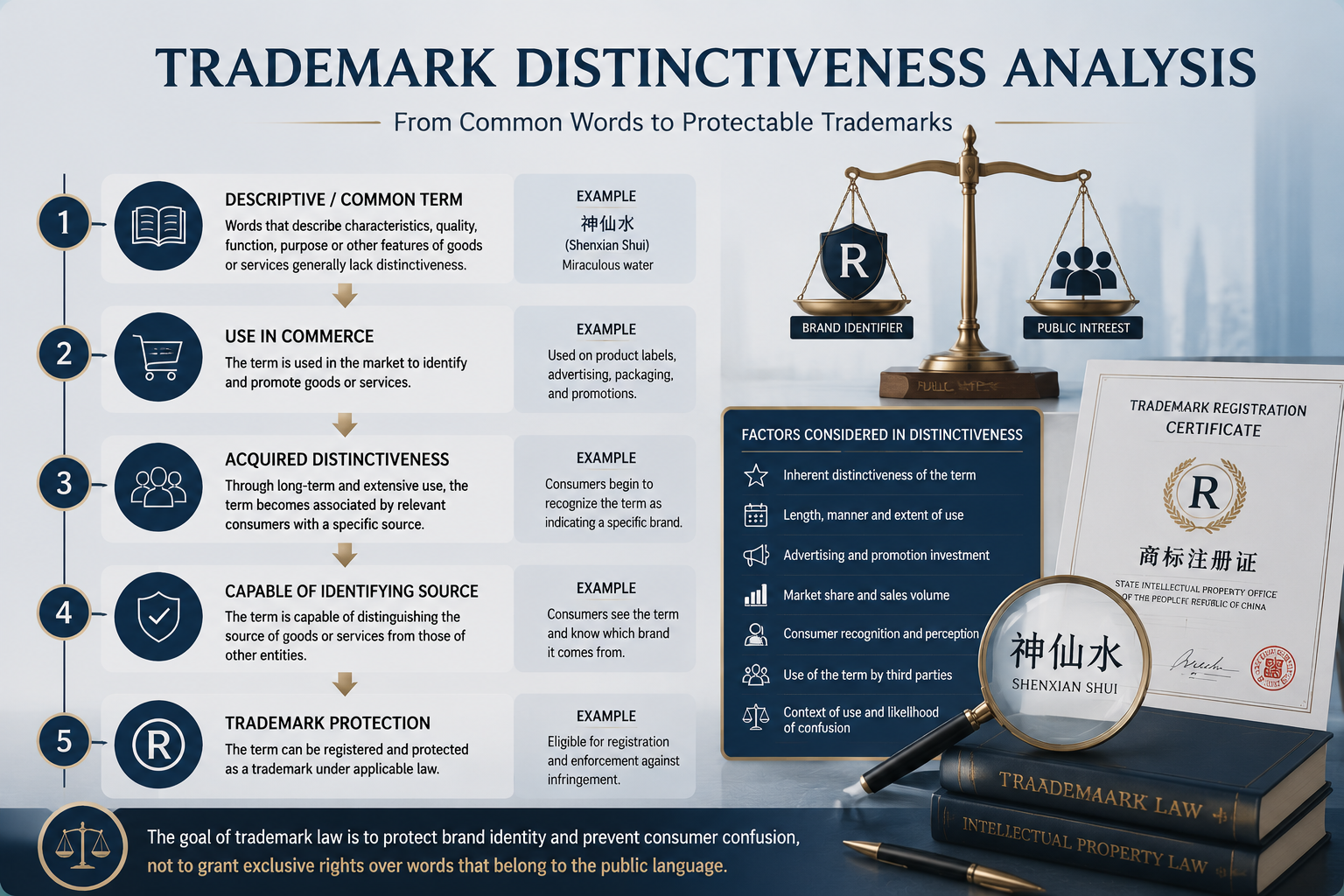
This means that although a term originally has a general meaning, extensive and continuous commercial use may cause consumers to associate that term with a specific company or product.
For example:
A common word may become strongly associated with a particular brand after years of advertising, sales, and market recognition.
However, acquired distinctiveness should be carefully evaluated.
The key question is not:
“Is the brand famous?”
The key question is:
“When consumers see this term, do they primarily understand it as identifying a specific commercial source?”
In the case of “Shenxian Shui,” the analysis should consider various factors, including:
- The duration and scope of use;
- Advertising investment;
- Market share;
- Consumer recognition;
- Whether third parties commonly use the term;
- Whether consumers regard the term as a brand identifier or merely a product description.
4. Trademark Fame Does Not Automatically Create Unlimited Exclusive Rights
One important principle in trademark law is:
The stronger the public meaning of a term, the more carefully its protection scope should be examined.
Trademark law protects commercial identification, but it does not grant companies ownership over ordinary language.
A company’s commercial success may increase the recognition of a trademark, but it should not automatically allow the company to control all ordinary expressions that contain common words.
Otherwise, widely used language resources could gradually become unavailable to the public.
The purpose of trademark law is to prevent consumer confusion, not to restrict legitimate communication or descriptive use.
5. The Difference Between Trademark Use and Descriptive Use
In trademark disputes involving common expressions, an important issue is whether the defendant is using the term as a trademark or merely using it descriptively.
For example:
Scenario 1:
“SK-II Shenxian Shui Essence”
In this situation, consumers may reasonably understand “Shenxian Shui” as referring to SK-II’s specific product.
The risk of trademark infringement may therefore be higher.
Scenario 2:
“Experience a Shenxian-like refreshing feeling”
This may simply be promotional language describing product effects rather than identifying the source of goods.
Scenario 3:
“A skincare essence similar to the famous Shenxian Shui”
This requires further analysis based on the overall presentation, context, and whether consumers may believe there is a connection with SK-II.
The key issue is:
Does the use of “Shenxian Shui” cause consumers to believe that the product comes from SK-II, or is it merely describing the characteristics and expected effects of the product?
6. The Importance of Maintaining a Balance Between Brand Protection and Public Interest
Trademark protection plays an essential role in encouraging innovation and protecting brand investment.
Well-known companies should receive appropriate protection against unauthorized exploitation of their reputation.
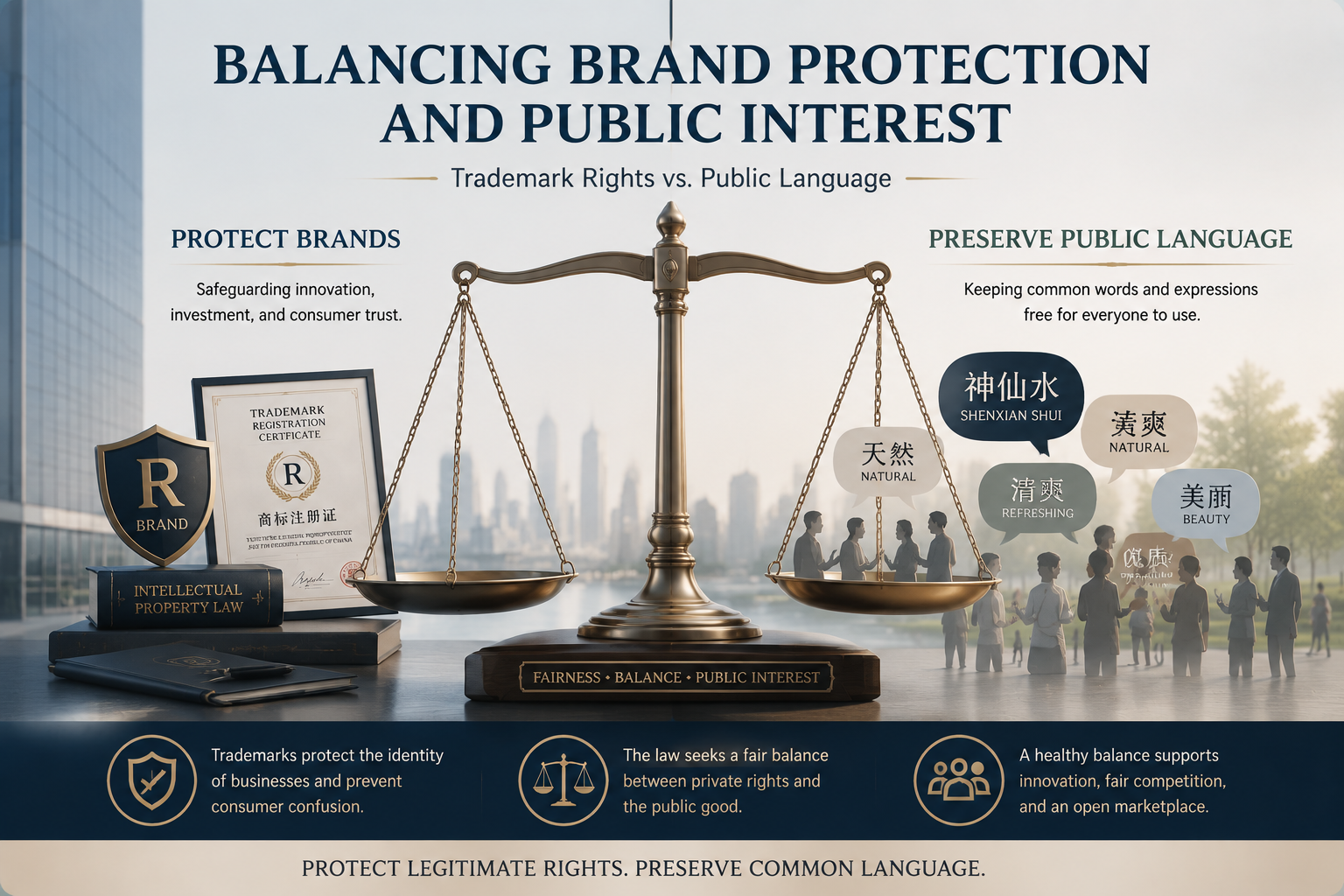
However, trademark rights must also maintain a reasonable balance with public interest.
Words and expressions that originate from common language, cultural heritage, or descriptive concepts should not be monopolized beyond the scope necessary to prevent confusion.
The protection of trademarks should not become a mechanism for controlling ordinary expressions used by society.
7. Practical Implications for Businesses
For foreign companies entering the Chinese market, the “Shenxian Shui” dispute provides several important lessons:
1. Choose trademarks with strong inherent distinctiveness
Invented words, unique combinations, and creative expressions generally provide broader protection than common descriptive terms.
2. Do not rely only on market reputation
A famous brand does not automatically mean every related expression enjoys unlimited trademark protection.
Businesses should carefully evaluate the legal scope of their trademark rights.
3. Develop a comprehensive trademark protection strategy
Companies should consider:
- Core brand registration;
- Product name protection;
- Defensive trademark filings;
- Monitoring and enforcement strategies.
A strong trademark portfolio is built through strategic planning, not only through registration.
Conclusion
The dispute surrounding “Shenxian Shui” highlights an important principle in trademark law:
Trademark protection is not about owning words; it is about protecting the ability of consumers to identify commercial origin.
From a linguistic perspective, “Shenxian Shui” carries broad cultural and descriptive meanings, and its inherent distinctiveness is relatively limited.
Even if extensive commercial use has strengthened consumer recognition of the term, the scope of protection should still be carefully assessed to ensure that trademark rights do not extend into unreasonable control over common language.
A balanced trademark system should protect both:
- legitimate brand value; and
- the public’s right to use ordinary expressions.
This balance is essential for maintaining fair competition and a healthy intellectual property environment.
About the Author
Kian Li is the Founder of Huixinhe IP, a China-based intellectual property service provider with more than 20 years of experience in trademark registration, patent protection, copyright protection, and IP enforcement.
Huixinhe IP assists international companies in protecting and managing their intellectual property rights in China and Asia through practical, strategic, and business-oriented solutions.


