


China NNN Agreements: How Foreign Companies Can Protect IP Before Working with Chinese Manufacturers
By Kian Li, Founder of Huixinhe IP
Published by Huixinhe IP Insights
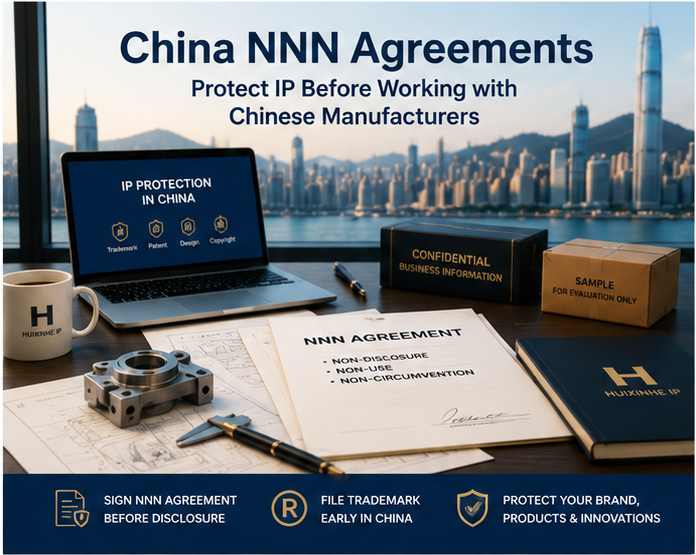
For many foreign companies, the first contact with China is not a lawsuit, a trademark dispute, or a patent filing. It is usually something much earlier and much quieter: a product drawing sent to a factory, a sample shipped for quotation, a packaging design shared with a supplier, or a video meeting with a potential manufacturing partner.
At that stage, the business conversation often feels practical and harmless. The foreign company wants to know the price, production capacity, lead time, mould cost, minimum order quantity, and whether the factory can make the product at the required quality level. The Chinese manufacturer, in turn, wants more technical information before giving a serious quotation.
This is exactly where many IP problems begin.
Before a product is manufactured, before a sales contract is signed, and sometimes before a trademark or design patent has even been filed, valuable business information may already have been disclosed. Once that information has been shared without a suitable protection structure, it can be difficult to control how it is used.
A China NNN agreement is designed to address this early-stage risk.
What is a China NNN Agreement?
NNN stands for Non-Disclosure, Non-Use, and Non-Circumvention.
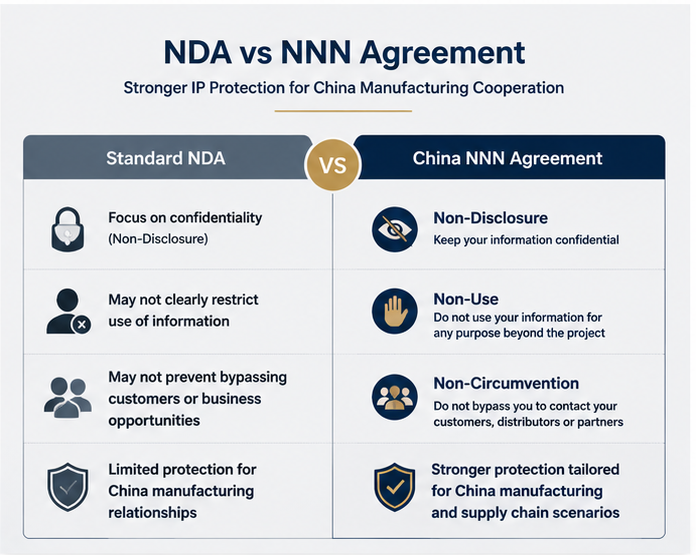
A traditional NDA usually focuses on confidentiality. It tells the receiving party not to disclose confidential information to others. That is useful, but in China-related manufacturing projects, disclosure is not the only risk.
In practice, the bigger risk is often that a supplier, subcontractor, trading company, or related manufacturer may use the information for its own benefit, or bypass the foreign company and deal directly with its customers, distributors, or market channels.
A well-drafted China NNN agreement should therefore cover three layers of protection:
Non-Disclosure means the factory or business partner must not disclose your drawings, designs, technical information, business plans, supplier lists, pricing, customer information, or other confidential materials to unauthorised third parties.
Non-Use means the receiving party must not use your information for any purpose other than the agreed project. This is important because a factory may not “disclose” your information to the public, but may still use it internally to make similar products, approach your competitors, or develop its own version.
Non-Circumvention means the Chinese party must not bypass you by contacting your customers, distributors, platforms, business partners, or supply chain contacts in order to take over the business opportunity.
For foreign companies working with Chinese manufacturers, this third element is often just as important as confidentiality.
Why a Standard NDA May Not Be Enough
Many foreign companies already have a standard NDA prepared by their home-country lawyer. They may assume that asking a Chinese factory to sign the same document is sufficient.
Sometimes it is not.
The issue is not whether the document looks professional. The issue is whether it is practical for the China-side relationship. A foreign-law NDA may be drafted for a different legal environment, a different enforcement route, and a different type of commercial risk. It may not clearly address factory-side use, subcontracting, related entities, tooling, product samples, Chinese-language evidence, or dispute resolution in a way that is practical for enforcement in China.
A China-related agreement should be drafted with the actual business scenario in mind. Who will receive the information? Is the counterparty the factory, a trading company, or an individual salesperson? Will moulds or tooling be created? Will subcontractors be involved? Will the factory see the full design, or only part of the technical information? Are product photos, packaging, software interface screenshots, source code, customer lists, or market channels being shared?
These details matter.
A short generic NDA may look simple, but simplicity can become a weakness if the agreement does not match the real risk.
When Should an NNN Agreement Be Signed?
The best time to sign an NNN agreement is before any important information is disclosed.
This means before sending:
product drawings;
3D files or CAD files;
samples or prototypes;
technical specifications;
packaging designs;
brand names or logos;
software screenshots or source code;
supplier or customer information;
mould designs;
manufacturing methods;
pricing structures;
business plans for the Chinese market.
In many disputes, the foreign company only considers legal protection after something has already gone wrong. By then, the factory may already have seen the product, quoted the cost, made samples, tested production, or introduced the idea to related parties.
An NNN agreement cannot solve every problem, but it creates an early written record of what information was provided, for what purpose, and under what restrictions. That written record may become important if a dispute later arises.
NNN Agreement and Trademark Protection
An NNN agreement should not be treated as a substitute for trademark filing.
This is a common mistake.
If your brand name, logo, product name, or Chinese brand name will be shown to a supplier, distributor, sales agent, exhibition organiser, packaging company, or online platform operator, you should consider trademark protection as early as possible.
China’s trademark system is strongly filing-based in practice. If a business partner, distributor, factory, or unrelated third party files your mark before you, it may become expensive and time-consuming to recover the rights. In some cases, your China market plan may be delayed, blocked, or made more difficult because your own brand is already in someone else’s name.
For this reason, foreign companies should not rely only on contract protection when brand rights are involved. Before serious discussions with Chinese partners, it is usually safer to review whether the relevant trademarks should be filed in China first.
This is particularly important for companies using:
English brand names;
Chinese brand names;
product series names;
logos;
packaging marks;
e-commerce store names;
brand names shown on samples or catalogues.
A contract can restrict one business partner. A trademark registration gives a clearer right against the market.
NNN Agreement and Patent or Design Protection
For products with technical features, structure, appearance, or functional improvements, companies should also consider whether patent or design protection is needed before disclosure.
This is especially important where the product has:
a new structure;
a distinctive product appearance;
a new mechanism;
a special component arrangement;
a packaging or container design;
a manufacturing improvement;
a technical solution not yet publicly disclosed.
If the product has already been widely disclosed, sold, displayed online, or sent to many factories without control, patent protection may become more difficult. Therefore, foreign companies should review the patent position before sending technical information broadly.
In practice, the right approach may be a combination of measures:
an NNN agreement before disclosure;
a trademark filing before brand exposure;
a design patent or utility model filing before public disclosure;
careful control of samples and drawings;
clear ownership terms for tooling and improvements;
documentation of what was shared and when.
No single document can protect everything. The stronger approach is to build a protection structure before the business expands.
What Should a China NNN Agreement Cover?
A practical China NNN agreement should not be a vague promise to “keep information confidential.” It should be specific enough to match the business.
Important points normally include:
the identity of the receiving party, including its Chinese legal name;
a clear definition of confidential information;
restrictions on disclosure, use, and circumvention;
control over employees, affiliates, subcontractors, and related factories;
rules for samples, moulds, tooling, prototypes, and technical files;
ownership of drawings, designs, brands, software, and improvements;
prohibition against applying for trademarks, patents, copyrights, domains, or platform stores based on the disclosed information;
return or destruction of materials after the project ends;
liability for breach;
governing law and dispute resolution;
language version and interpretation rules.
One point deserves special attention: the counterparty must be correctly identified.
In China-related business, foreign companies sometimes negotiate with one person but sign with another company. Sometimes the business card says one company, the invoice comes from another company, and the factory licence belongs to a third entity. If the wrong party signs the agreement, enforcement may become difficult.
Before sharing valuable information, it is sensible to confirm who the real contracting party is.
Common Mistakes Foreign Companies Make
At Huixinhe IP, we often see the same pattern in early-stage China manufacturing projects.
The foreign company is careful with price and quality, but not careful enough with IP sequence.
The company may spend weeks comparing factories but delay trademark filing. It may send full technical drawings before signing any protective agreement. It may allow a supplier to arrange mould development without clarifying who owns the mould or the improved design. It may use a standard NDA from another jurisdiction without considering whether the document is suitable for China-side enforcement.
Another common mistake is trusting the relationship too early.
A good supplier relationship is valuable, but trust should be built on clear rules. A serious factory should understand why a foreign customer wants reasonable protection before disclosing commercial or technical information. If a potential partner refuses to sign any protective document at all, that refusal itself may be a risk signal.
NNN Agreement Is Only One Part of IP Protection
A China NNN agreement is useful, but it should not be treated as the whole protection plan.
Before working with Chinese manufacturers, foreign companies should consider a broader IP review:
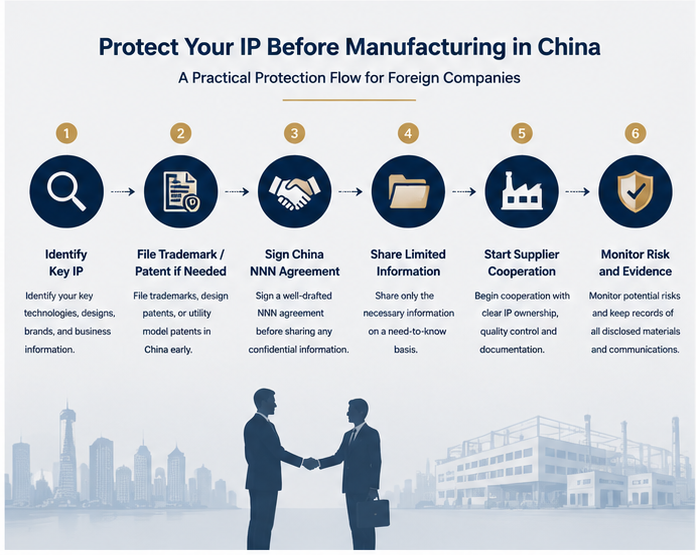
Have the key trademarks been filed in China?
Is there a Chinese brand name that also needs protection?
Should the product appearance be protected by design patent?
Does the technical structure justify utility model or invention patent filing?
Has any confidential information already been publicly disclosed?
Will any supplier receive full technical files?
Who owns the moulds, samples, drawings, and improvements?
Will the products be sold in China, exported from China, or both?
Are there existing third-party rights that may create infringement risks?
This review does not need to be complicated, but it should be done before the company is commercially committed.
Once the product has been copied, the brand has been filed by someone else, or the factory has already developed a competing version, the cost of solving the problem will usually be much higher.
Practical Checklist Before Working with a Chinese Manufacturer
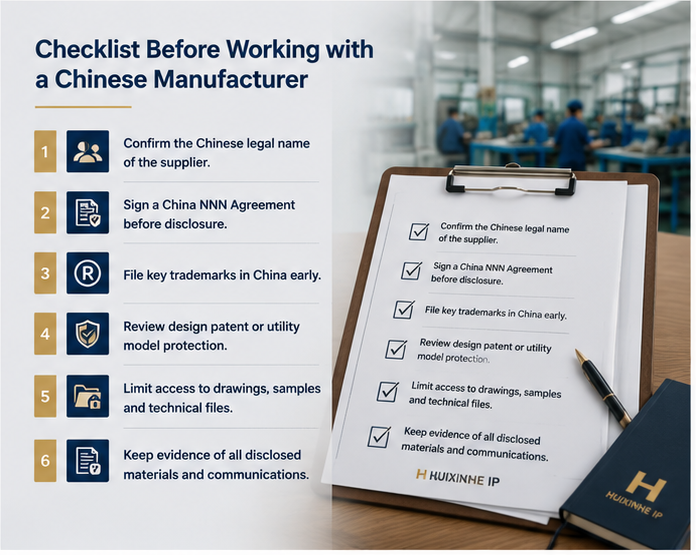
Before sending important information to a Chinese factory or supplier, foreign companies should consider the following steps:
Confirm the full Chinese legal name of the counterparty.
Sign an appropriate China NNN agreement before disclosure.
File key trademarks in China before exposing the brand.
Review whether design patent or utility model protection is needed.
Limit disclosure to what is necessary at each stage.
Mark sensitive documents as confidential.
Keep records of drawings, samples, emails, file transfers, and meeting notes.
Clarify ownership of moulds, tooling, improvements, and derivative designs.
Avoid sending full technical files to multiple suppliers without control.
Prepare an enforcement plan in case copying or circumvention occurs.
The goal is not to make business with Chinese manufacturers difficult. The goal is to make cooperation safer, clearer, and more predictable.
Conclusion
China remains one of the most important manufacturing bases in the world. For many foreign companies, working with Chinese manufacturers is commercially necessary and often highly productive. The real issue is not whether to work with China, but how to structure the cooperation properly.
IP protection should not start after a dispute. It should start before disclosure.
A China NNN agreement can be an important first step, especially when combined with trademark filing, patent review, careful supplier selection, and practical control over technical and commercial information.
For foreign companies preparing to source, manufacture, develop, or launch products through Chinese partners, early preparation is usually far less costly than later enforcement.
Huixinhe IP supports overseas companies with China IP strategy, NNN agreements, trademark and patent protection, factory-side risk control, and IP enforcement. If you are preparing to work with a Chinese manufacturer, our team can help review the risks before key information is disclosed


