


Trademark Squatting in China: What Foreign Companies Should Know Before Entering the Market
By Kian Li, Founder of Huixinhe IP
Published in June 2026

For many foreign companies, trademark squatting in China is not something they think about at the beginning. They usually focus on sales channels, distributors, factories, exhibitions, e-commerce platforms, and market promotion. Trademark registration is often left until later.
That delay can become expensive.
In China, a trademark problem can quickly turn into a business problem. A foreign brand may discover that its name has already been registered by another party. That party may be a stranger, a distributor, a supplier, an OEM factory, or even a former business partner. Once this happens, the real brand owner may face online complaints, exhibition disruption, dealer uncertainty, and pressure to buy back its own brand.
Trademark squatting in China is not only a legal risk. It is a market control risk.
What Is Trademark Squatting in China
Trademark squatting generally refers to a situation where someone registers a trademark that belongs, in commercial reality, to another brand owner.
For foreign companies, this often happens when a Chinese party files the English brand name, Chinese translation, Chinese transliteration, logo, or a similar mark before the original overseas brand owner files in China.
The squatter may not have created the brand. It may not own the product, technology, reputation, or overseas market goodwill. But once it obtains a trademark registration in China, it may try to use that registration as leverage.
In practice, trademark squatters may:
- block the foreign brand from entering the Chinese market;
- file complaints on e-commerce platforms;
- interfere with exhibitions or trade shows;
- pressure the brand owner to pay for assignment;
- continue selling products under the brand after a distribution relationship ends;
- register similar marks in related classes;
- create confusion among dealers and customers.
This is why foreign companies should treat China trademark protection as an early business decision, not a later legal formality.
Why Foreign Brands Are Often Targeted
Foreign brands are common targets for trademark squatting in China because many of them enter the market before completing trademark protection.
Several situations are especially risky.
A company may have used its brand overseas for many years and assume that overseas reputation is enough. It is not.
A company may appoint a Chinese distributor before filing trademarks in China. The distributor then becomes familiar with the brand, products, pricing, channels, and future market potential.
A company may register only the English name and ignore the Chinese name. This leaves room for others to register the Chinese version.
A company may work with an OEM factory or supplier before securing trademark ownership. The factory sees the product, packaging, and brand value before any China filing is completed.
A company may attend exhibitions, promote products, or open online channels before trademark registration is in place. Public exposure increases the chance that someone notices and files first.
In my experience, many trademark squatting cases do not happen because the foreign company had no awareness of IP protection. They happen because the company acted too late.
Distributor-Related Trademark Squatting
Among all trademark squatting risks, distributor-related squatting is one of the most dangerous.
A distributor is not an outsider. It understands the brand. It knows the products. It knows whether the brand is selling well. It knows whether the overseas company is serious about the Chinese market.
This creates a practical risk.
If the foreign brand owner has not filed the trademark in China, a distributor may be tempted to register the mark in its own name. At the beginning, the relationship may still be good. The brand owner may not notice the filing. Sometimes the distributor may even say it is “helping” with local protection.
The real problem appears when the relationship ends.
The former distributor may continue using the brand. It may claim to be the China general distributor. It may complain against the new authorized distributor. It may use the registered trademark to block genuine products from being sold online or displayed at exhibitions.
This is not rare. It is one of the most common patterns in foreign brand trademark disputes in China.
A Practical Example
One overseas automotive care brand had been sold in several markets for years. Its products included car cleaning chemicals, paint coating products, tire care products, and other professional automotive beauty products. The brand entered China through a local distributor and gradually built a presence in offline channels, exhibitions, and e-commerce.
The overseas brand owner made one serious mistake: it did not register the English brand name or Chinese brand name in China.
During the distribution relationship, the local distributor’s controller filed the brand name in China. The filings covered the key product and service categories connected to automotive cleaning products and car beauty services. Later, several similar marks were also filed.
After the distribution relationship ended, the former distributor continued using the brand and claimed to be the official China representative. It then used the registered trademarks to file complaints against the new legitimate distributor appointed by the overseas brand owner.
The genuine brand owner suddenly became passive. Products were affected on online platforms. Exhibition activities were disrupted. Dealers became uncertain. The brand had to spend years collecting evidence, filing invalidation actions, and pursuing legal remedies.
The foreign brand owner eventually obtained a favorable result. The bad-faith nature of the filings was recognized, unfair competition was found, and compensation was awarded. But the commercial damage was much larger than the compensation.
Several years of market opportunity were lost.
This is the real cost of trademark squatting in China.
What Damage Can Trademark Squatting Cause
The most direct damage is loss of control.
If another party owns the trademark registration, the foreign brand owner may not be able to use its own brand freely in China. Even worse, the registered owner may use the trademark against the real brand owner.
Common consequences include:
- online product listings being taken down;
- trade show booths being challenged;
- distributors refusing to cooperate because of legal uncertainty;
- customers questioning whether the genuine brand is legitimate;
- pressure to change brand names temporarily;
- higher legal and evidence collection costs;
- delay in market expansion;
- long-term damage to dealer confidence.
In some cases, the foreign company finally wins the dispute, but the market has already moved on. Competitors may have entered. Dealers may have changed brands. The original growth opportunity may not return.
That is why prevention is usually much cheaper than recovery.
What Can a Foreign Company Do If Its Trademark Has Been Squatted
If a foreign company discovers that its trademark has already been registered by another party in China, it should not act emotionally. The first step is to understand the facts clearly.
Important questions include:
- Who filed the trademark?
- When was it filed?
- What classes were covered?
- Is the mark identical or similar?
- Was there a prior business relationship?
- Did the foreign company use the mark in China before the filing?
- Is there evidence of bad faith?
- Has the squatter filed multiple similar marks?
- Has the squatter used the trademark to complain or disrupt business?
Depending on the situation, possible actions may include trademark opposition, trademark invalidation, negotiation, evidence preservation, unfair competition claims, platform complaint defense, or civil litigation.
If the mark is still in the publication period, opposition may be considered.
If the mark has already been registered, invalidation may be necessary.
If the squatter was a distributor, supplier, or business partner, evidence of the prior relationship may be important.
If the squatter has used the registration to attack the genuine brand owner, this conduct may support a broader unfair competition claim.
Every case depends on evidence. Without evidence, even a strong commercial story may be difficult to prove.
Evidence Matters
In trademark squatting disputes, evidence often decides the strength of the case.
Useful evidence may include:
- overseas trademark registrations;
- historical product sales records;
- distributor agreements;
- emails and WeChat communications;
- invoices and shipping documents;
- exhibition materials;
- website screenshots;
- e-commerce records;
- advertisements;
- media reports;
- product packaging;
- evidence showing the squatter knew the brand;
- evidence of bad-faith complaints or market disruption.
Foreign companies should not wait until litigation begins to collect evidence. Important evidence may disappear quickly, especially online.
When a trademark problem appears, evidence preservation should start early.
How to Prevent Trademark Squatting in China
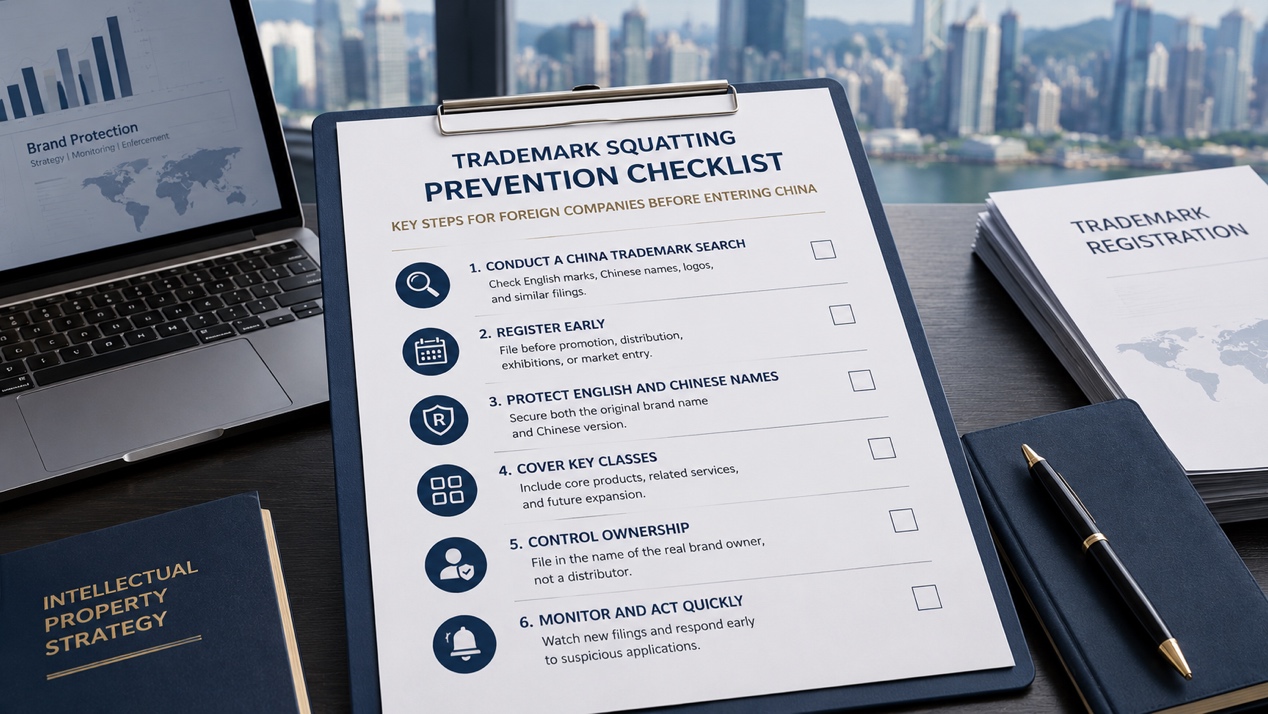
The best way to handle trademark squatting is to prevent it before it happens.
Foreign companies should consider the following steps before entering the Chinese market.
First, file early.
The trademark should be filed before public promotion, distributor appointment, exhibition participation, OEM production, or large-scale sales.
Second, register both the English and Chinese names.
The Chinese name should not be left to the distributor or the market. If the company does not choose and protect a Chinese name, someone else may do it first.
Third, choose the right classes.
The filing strategy should cover the core product class, related service classes, and future business expansion. Filing too narrowly may create risk later.
Fourth, file in the name of the real brand owner.
The distributor, supplier, or factory should not own the trademark unless there is a very clear and controlled legal arrangement.
Fifth, include trademark clauses in contracts.
Distribution, OEM, and supply agreements should clearly state that the local partner has no right to register the same or similar marks.
Sixth, monitor new filings.
Trademark monitoring can help identify suspicious applications early, when opposition or other action may still be easier.
Seventh, act quickly if a problem appears.
Delay usually helps the squatter, not the brand owner.
A Simple Rule for Foreign Companies
For foreign companies entering China, the rule should be simple:
Do not wait until the brand becomes valuable in China before protecting it.
By the time a distributor, supplier, or third party sees the value, the risk may already have increased.
Trademark protection should come before market exposure. This is especially important for brands in sectors such as consumer goods, automotive products, cosmetics, food and beverage, technology, fashion, industrial products, and cross-border e-commerce.
Any brand that depends on reputation should take China trademark filing seriously.
Final Thoughts
Trademark squatting in China is not just about someone filing a piece of paper before you do. It can affect sales, distribution, online platforms, exhibitions, customer trust, and long-term brand control.
For foreign companies, the most important protection is early planning.
Register the English mark. Register the Chinese name. Cover the correct classes. Control ownership. Watch distributors and suppliers carefully. Keep evidence. Monitor new filings. Act quickly when risk appears.
In many China trademark disputes, the foreign brand owner does not lose because it has no real brand. It loses time, money, and market opportunity because it did not secure the trademark early enough.
Huixinhe IP supports foreign companies with China trademark search, trademark registration, bad-faith trademark monitoring, opposition, invalidation, distributor-related trademark disputes, and brand protection matters.
If your company is preparing to enter the Chinese market or has already discovered a trademark squatting risk, our team can provide practical support.
Talk To Us


