


How to Register a Trademark in China: A Practical Guide for Foreign Companies
By Kian Li, Founder of Huixinhe IP
Published on June 2026

For foreign companies, China trademark registration should not be treated as a small administrative matter. It is often one of the first legal steps that decides whether a brand can enter the market smoothly, work with distributors safely, sell online without disruption, and respond effectively when infringement appears.
Many companies only think about China trademark registration after they start selling products, appointing distributors, attending exhibitions, or working with factories. By then, the risk may already exist. Someone else may have filed the same mark, a similar mark, a Chinese version of the brand name, or related trademarks in important classes.
China trademark registration is not only about owning a certificate. It is about controlling the commercial use of your brand.
Why China Trademark Registration for Foreign Companies Should Start Early
A trademark registered in Australia, the United States, Europe, Japan, or another market does not automatically protect the brand in China.
This is one of the most common misunderstandings among foreign brand owners. A company may have used its brand overseas for many years and built a strong reputation in its home market, but that does not mean it has secured trademark rights in China.
If a foreign company plans to sell products in China, manufacture products in China, appoint distributors, attend trade shows, open online stores, or supply products to Chinese customers, it should consider trademark filing as early as possible.
Waiting until the brand becomes visible can create unnecessary risk. In many cases, the first serious trademark problem appears only after the business starts to grow.
A Practical Example: When the Distributor Registered the Brand First
An Australian automotive care brand, referred to here as 9B, had been sold overseas for many years. Its products included paint coatings, interior cleaning products, tire care products, car wash liquids, and other professional car beauty products. The brand had a stable reputation in Australia, New Zealand, and parts of Southeast Asia.
After 2010, the brand entered the Chinese market through a local distributor. The products were sold through car beauty shops, exhibitions, offline channels, and cross-border e-commerce.
The problem was simple but serious: the Australian brand owner did not register “9B” in China. It did not register the English mark, and it did not secure a Chinese brand name. The Chinese distributor used the brand in the market, but the overseas headquarters did not conduct a trademark search or file applications in its own name.
During the distribution relationship, the controller of the Chinese distributor privately applied for the “9B” trademark in China. The filings covered key classes, including Class 3 for cleaning products and automotive care chemicals, and Class 37 for car cleaning and car beauty services. Later, several similar trademarks were also filed in related categories.
After the distribution relationship ended, the former distributor continued to use “9B” and claimed to be the China general distributor of the Australian brand. It then used the registered marks to complain against the new legitimate distributor appointed by the Australian brand owner.
The consequences were immediate. Exhibition displays were interrupted. Online product links were taken down. Dealers became uncertain. The legitimate brand owner suddenly found itself in a difficult position: it owned the real brand overseas, but it did not control the trademark registration in China.
The dispute lasted for years. The overseas brand owner had to collect evidence, file invalidation actions, and bring legal claims against the former distributor and its controller. The court eventually recognized the bad-faith nature of the registrations and found unfair competition. Compensation was awarded, and the disputed marks were invalidated.
But the real commercial damage was far greater than the compensation. Legal fees, evidence preservation, trademark invalidation costs, lost market opportunities, dealer loss, and brand rebuilding expenses created a much heavier burden. More importantly, several years of market development were lost.
This is why trademark filing should not wait until a dispute happens.
For foreign brands entering China, the safer rule is:
Register first. Promote later. Appoint distributors carefully.
Start with a Trademark Search
Before filing a trademark in China, a search should be conducted.
The search should not only check the exact English brand name. It should also consider:
- similar English marks;
- logo marks;
- Chinese translations;
- Chinese transliterations;
- marks filed by distributors, suppliers, or related parties;
- marks in related product and service classes.
A search cannot guarantee that a trademark will be approved, but it helps identify risks before money is spent on filing, packaging, marketing, exhibitions, or distribution.
For foreign companies, this step is especially important because many trademark conflicts in China are not obvious at first glance. A similar mark in a related class may create problems later, especially if the brand plans to expand its product line.
Register Both the English Mark and Chinese Name
Many foreign companies only register their English brand name. That is often not enough.
In China, customers, distributors, dealers, media, and online platforms may naturally create or use a Chinese version of a foreign brand name. If the company does not control that Chinese name, someone else may register it first.
A complete China trademark strategy should usually consider:
- the original English brand name;
- the Chinese translation;
- the Chinese transliteration;
- the logo;
- key product series names;
- important slogans or sub-brands.
The Chinese name can become extremely valuable. In some industries, the Chinese name may even be more widely used than the English name in the local market.
Foreign companies should not leave the Chinese name to the distributor or the market to decide.
Choose the Right Trademark Classes
Trademark protection in China depends heavily on correct classification.
In the 9B example, the brand was used for automotive care products and related car beauty services. The key classes included:
- Class 3 for cleaning products and automotive care chemicals;
- Class 37 for car cleaning and car beauty services.
If the brand owner had registered these classes earlier, the later dispute would likely have been much easier to control.
Foreign companies should not only file in the most obvious product class. They should also consider related services, future expansion, e-commerce activities, distribution channels, and enforcement needs.
For example, a company may need to consider protection for:
- core products;
- retail or online sales;
- repair, maintenance, or service activities;
- packaging;
- software or digital products;
- franchise or service operations;
- related product lines.
A narrow filing strategy may save cost at the beginning, but it can become expensive later.
File in the Name of the Real Brand Owner
This is one of the most important points.
The trademark should generally be filed in the name of the actual brand owner, not the distributor, supplier, factory, agent, or local business partner.
At the beginning of a business relationship, letting a local partner file the trademark may seem convenient. But when the relationship changes, that convenience can become a serious risk.
Foreign companies should make sure their contracts clearly state that:
- the trademark belongs to the brand owner;
- the distributor has no right to register the same or similar marks;
- the distributor must stop using the mark after termination;
- any local filing made on behalf of the brand must be assigned to the brand owner;
- unauthorized filing may be treated as bad-faith conduct.
In practice, many trademark disputes begin inside a business relationship, not outside it. Distributors, suppliers, OEM factories, and local partners are often the parties who know the brand best and understand its commercial value.
That is exactly why ownership control matters.
Prepare the Application Properly
Once the search and filing strategy are confirmed, the trademark application can be prepared.
A typical China trademark application usually involves:
- applicant name and address;
- trademark specimen;
- selected class and goods or services;
- applicant identity or company registration documents;
- filing authorization documents;
- Chinese translation of applicant information where required.
For foreign companies, the wording of goods and services should be handled carefully. Poor classification or inaccurate descriptions may weaken the value of the registration or create problems in enforcement.
The goal is not simply to file something. The goal is to file in a way that supports the company’s real business activities.
Watch the Examination and Publication Process
After filing, the application will be examined by the trademark authority.
The application may be approved, partially refused, refused, or opposed by a third party after publication. If there is a refusal, the applicant may consider filing a refusal review depending on the reason and the strength of the case.
If the mark is published and no successful opposition is filed, it may proceed to registration.
Foreign companies should understand that trademark registration is a process, not a one-day action. Timing, monitoring, and response strategy all matter.
Registration Is Only the Beginning
A registered trademark is the foundation of brand protection, but it is not the end of the work.
After registration, companies should continue to monitor:
- similar trademark filings;
- distributor or supplier use;
- online platform listings;
- counterfeit products;
- unauthorized promotional materials;
- domain names and store names;
- market activity by former partners.
If infringement appears, evidence should be preserved quickly. In some cases, action may involve platform complaints, administrative complaints, customs recordal, civil litigation, or trademark invalidation procedures.
The earlier the evidence is secured, the easier it is to act.
Common Mistakes Foreign Companies Should Avoid
The same mistakes appear again and again in China trademark matters.
The most common ones include:
- entering the market before filing;
- registering only the English name;
- ignoring the Chinese brand name;
- filing in too few classes;
- allowing a distributor to control the trademark;
- failing to include IP clauses in distribution or OEM agreements;
- ignoring similar trademarks;
- taking action only after complaints or takedowns happen.
The 9B case is a strong reminder. The overseas brand owner eventually fought back, but it took years. Winning the case did not fully repair the lost market opportunity.
In trademark protection, prevention is often much cheaper than recovery.
A Practical Checklist Before Entering China
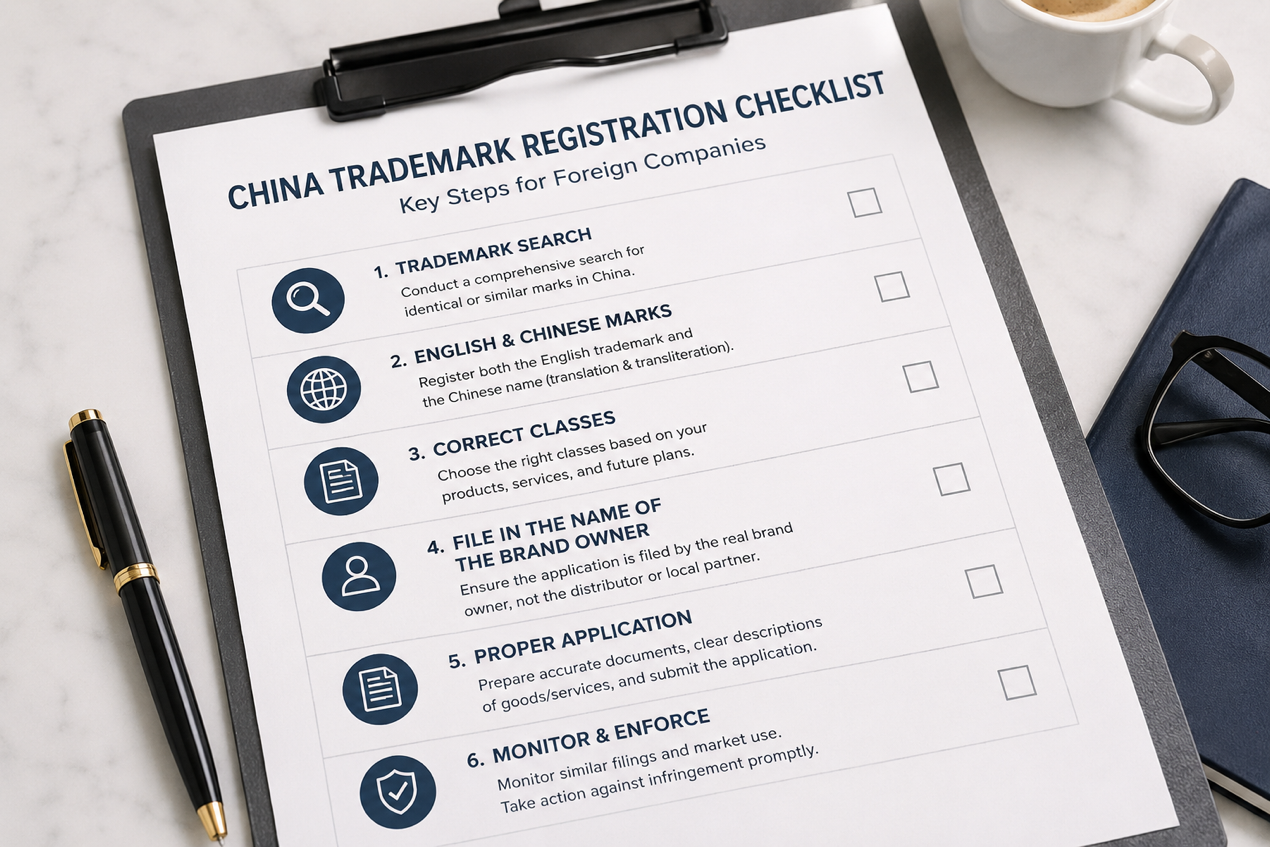
Before selling, manufacturing, appointing a distributor, or promoting a brand in China, a foreign company should ask:
- Have we searched our English trademark in China?
- Have we chosen and protected a Chinese brand name?
- Have we filed in the correct classes?
- Have we considered related services and future product lines?
- Is the trademark filed in the name of the real brand owner?
- Do our distributor agreements prohibit trademark filing by the distributor?
- Have we checked whether a distributor, supplier, or partner has already filed similar marks?
- Do we have a plan for online enforcement?
- Should we consider customs recordal?
- Are we monitoring new filings and market use?
If these questions are not clear, the company may already be exposed to risk.
Final Thoughts
China trademark registration should be treated as part of business planning, not as a formality after the market has already been tested.
For foreign companies, the key is to act early, file strategically, and keep control of the brand from the beginning.
A strong trademark strategy should cover the English mark, Chinese name, correct classes, ownership control, distributor risk, online enforcement, and future market expansion.
The lesson from many real disputes is clear:
A trademark problem in China is rarely just a legal problem. It can quickly become a sales problem, a distributor problem, an e-commerce problem, and a market access problem.
Working with an experienced China trademark agent can help foreign companies avoid filing mistakes, classification issues, distributor-related trademark risks, and unnecessary enforcement costs.
Huixinhe IP supports foreign companies with China trademark search, filing strategy, trademark registration, refusal review, opposition, invalidation, enforcement, and brand protection matters.
If your company is preparing to register a trademark in China or has already found a trademark risk, our team can provide practical support.
Talk To Us


